I understand why drivers search for the Landstar load board.
I used to be one of those guys on the outside trying to get a look. I wanted to know what kind of Landstar loads were really out there. Was the freight real? Was the money real? Was there enough opportunity to make the move worth it?
So I get it. When you're thinking about leasing onto Landstar, the load board feels like the thing you need to see.
Here's the problem, though: a random snapshot of the Landstar freight board from the outside doesn't tell you what you think it does.
Why drivers want to see the Landstar load board
Most owner operators aren't being nosy. They're trying to protect themselves.
Before you lease on anywhere, you want proof. You want to know whether the carrier has freight in the lanes you care about, whether the rates are worth messing with, and whether you're walking into real opportunity or just another recruiting pitch.
That is why people search for Landstar load board, Landstar loading board, Landstar freight board, Landstar loads, and Landstar public load board.
The search makes sense. The answer just isn't as simple as showing somebody a screen.
A load board screenshot is only a frozen moment
The Landstar load board changes constantly. A load that's there right now may be gone before you finish your coffee. A load that looks average may be the right move for one truck and a terrible one for another. A load that looks great may leave you somewhere you don't want to be.
That's why YouTube videos and random screenshots can mislead you. They may be real, but they're still only showing what happened to be sitting there at that moment.
The good loads don't usually sit around waiting for someone to study them. A lot of them move fast. Some get posted and booked within minutes. Some are covered before they ever show up on the board in any meaningful way.
So if you're on the outside trying to judge the whole system from a glimpse of the board, you're probably not seeing the best part of it.
The good Landstar loads can disappear fast
This is the part a lot of drivers miss.
When a good load hits the board, it may not stay there long. If it pays right, runs a good lane, has good timing, and fits the equipment, somebody who knows what they're looking at may grab it in a hurry.
That means the freight sitting on the board isn't always a fair sample of the freight that exists. Sometimes you're looking at loads that haven't fit anybody yet. Sometimes it's loads that need the right truck in the right place. Sometimes it's freight that's fine, but only if it matches your plan.
That doesn't mean the board is bad. It means the board isn't a museum. It's a live market.
Some freight may never really make it to the board
Everybody talks about agent relationships until the phrase starts to sound worn out. But this is where those relationships get real.
If an agent has a good load, what do you think happens first?
A lot of the time, the agent calls the BCOs they already know. The ones who answer the phone. The ones who've handled freight cleanly before. The ones who do what they say they'll do. The ones who fit that lane, that customer, or that kind of freight.
Then, if the load still needs a truck, it may hit the board.
That's not a conspiracy. That's business. If you had a customer counting on you and you knew three operators who could handle the load, you'd probably call them before throwing it out to the whole world too.
That's why judging Landstar only by what's sitting on the board can be a mistake. The board is important, but relationships can move freight before the board ever tells the whole story.
Thinking about Landstar?
If you understand that the load board is a tool, not a guarantee, Landstar may be worth a serious look.
Apply to Landstar NowWhat about the Landstar public load board?
There's another wrinkle here. When people search for Landstar public load board, they may not be talking about the same thing BCOs use.
Landstar has freight that approved outside carriers may be able to see or book through Landstar's outside carrier tools. That's not the same as being a Landstar BCO looking at the internal freight network.
From what I remember, the outside carrier board may show available loads without showing rates the way a BCO sees them inside the system. More importantly, not every load available to BCOs is necessarily posted for outside carriers.
Some customers want BCOs. Some freight is better kept inside the Landstar network. And Landstar gives agents financial incentives to use BCOs instead of outside carriers when possible. I do not know the exact commission split numbers, but the incentive is real.
So if you're looking at some outside version of a Landstar freight board, be careful about the conclusions you draw. You may not be seeing the same opportunity a BCO sees.
The board still matters
None of this means the Landstar load board is useless. It matters a lot.
The board can show you patterns and lanes. It can show which agents are active in certain types of freight. It can show where freight is moving and where you might get stuck. It helps you compare options, watch timing, and make decisions.
But the board doesn't do the thinking for you.
A new BCO might look at a load and only see the rate. An experienced operator looks past that:
- Where does the load leave me?
- What's the reload market like there?
- How many empty miles am I burning?
- How much time is tied up?
- Does this agent know the customer?
- Is the appointment realistic?
- Does this fit my equipment and my week?
That's why two BCOs can look at the same Landstar loads and make completely different calls. One sees gross revenue. The other sees the whole week.
A real Sunday evening load board search
Here's what this looks like in real life. On a Sunday evening, the Landstar load board was showing more than 135,000 posted loads. That sounds huge, but a raw load count doesn't tell you much by itself.
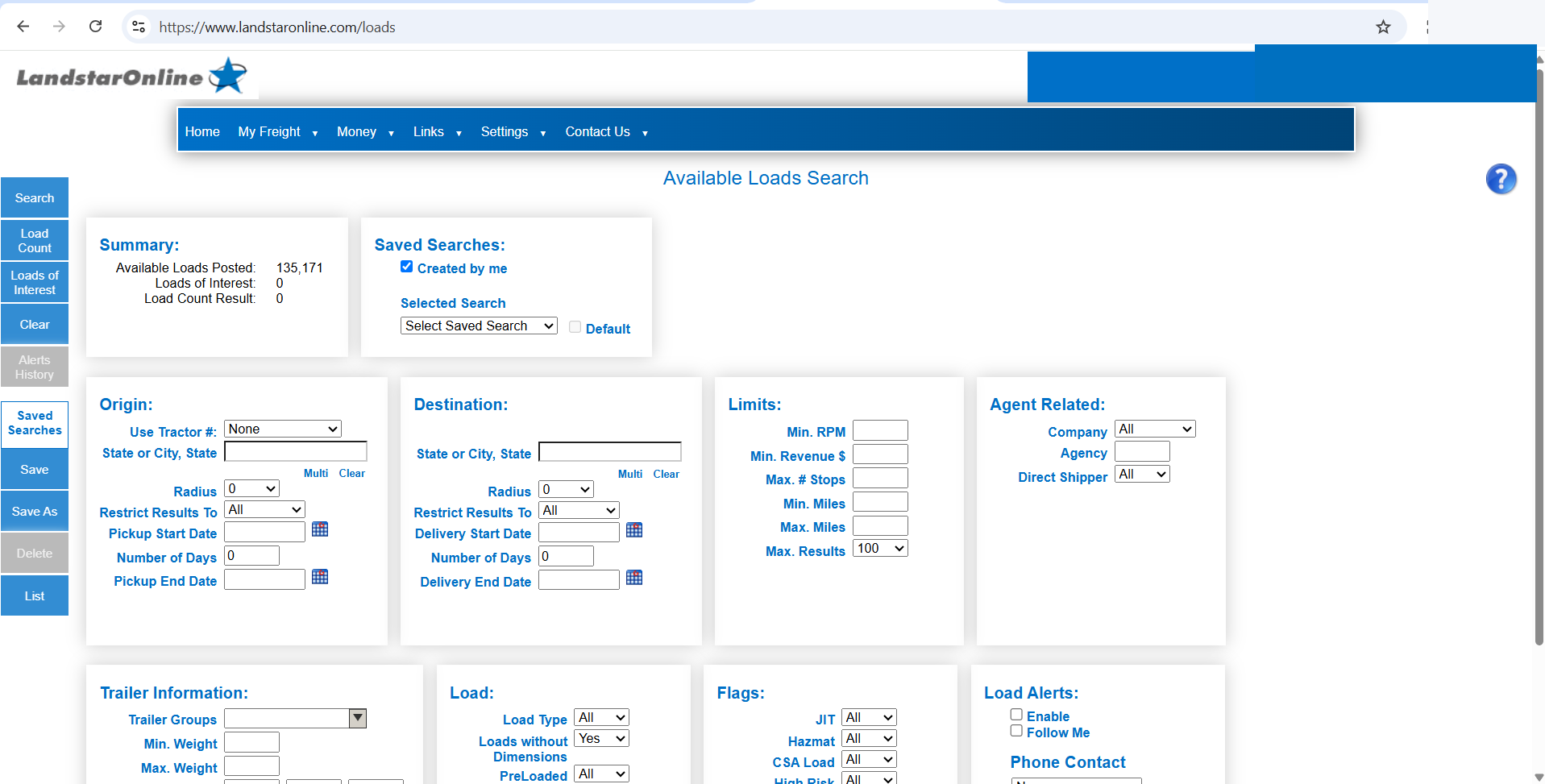
I filtered the search to van freight from the Midwest to anywhere, with a $4 per mile minimum and a $4,000 minimum rate. The desktop version only shows so many results, so seeing 500-plus loads doesn't mean you've looked at the whole market. Then I filtered to direct shippers only, and the list dropped to 154 loads.
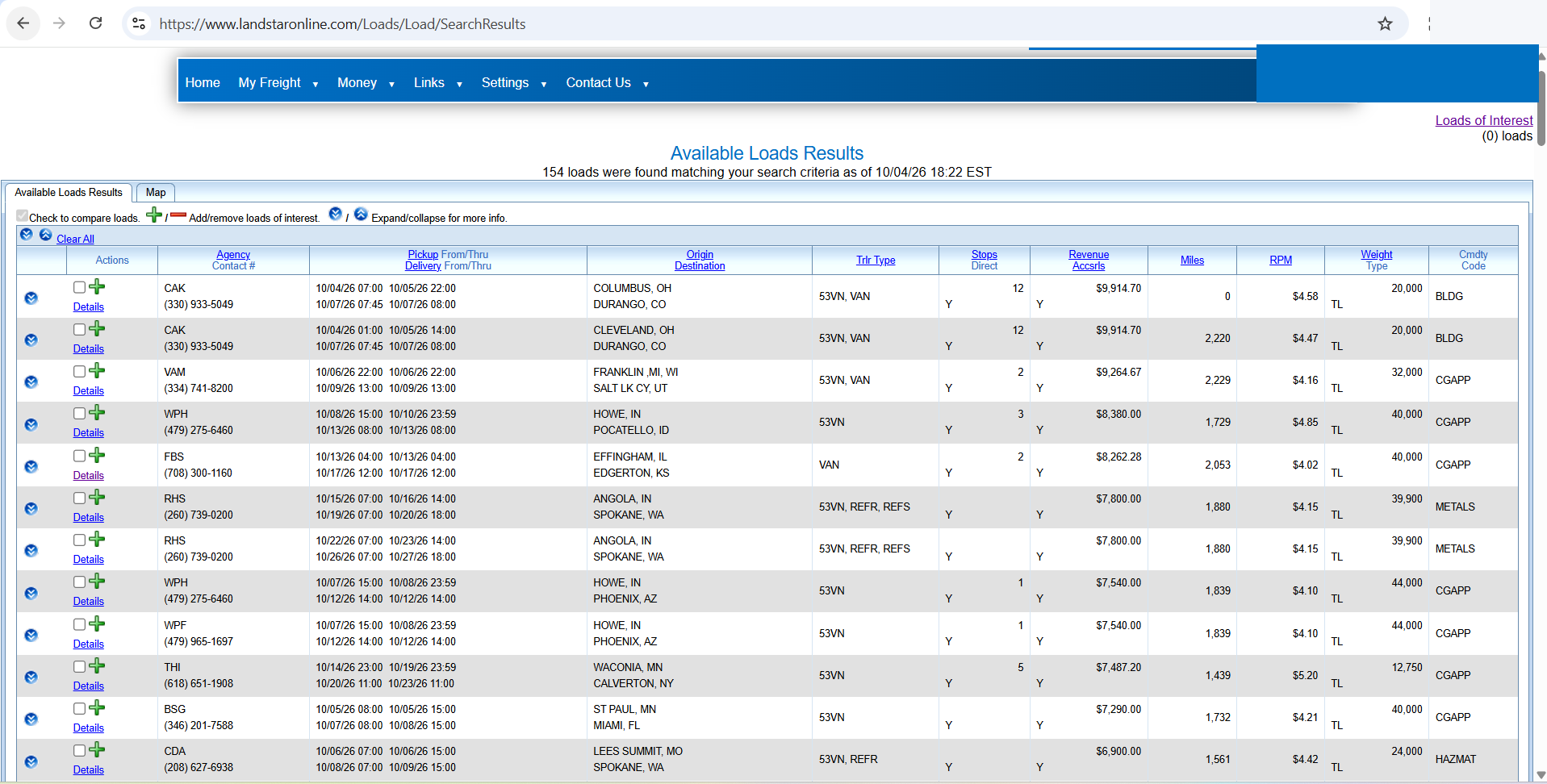
That's already useful. Direct shipper freight isn't automatically good, and non-direct freight isn't automatically bad. But if I'm choosing between two similar loads, I pay attention to that direct shipper flag. Third-party broker freight can be fine, but it's also where more games tend to show up.
The top results were Colorado, Utah, Idaho, multi-stop loads, and other freight that didn't jump out at me. That doesn't mean those loads were bad. It means I'm already thinking about where the load leaves me. If a load sends me into a dead zone, the rate going in has to cover the pain of getting back out.
Say I'm looking at Chicago to Denver. I'm not just thinking about the thousand miles going west. I'm also thinking about the thousand miles it may take to get back to a better freight market. If I want $4 per mile, I don't want $4,000 to go to Denver. I want a number that respects the round-trip problem.
Then I saw an Indianapolis to Laredo load paying $5.10 per mile. That's worth opening. But once you open the details, it's a team load. Good for the right team, not much use to most solo operators. So I filtered to solo loads only, and the list dropped again.
Before I start chasing loads, I want to know my floor. If I don't own the trailer and I'm getting 65% of line haul plus fuel surcharge, a $4 per mile line-haul load isn't $4 per mile to my truck. It's closer to $2.60 per mile before fuel surcharge. Depending on the fuel surcharge, it may land around $2.80 per mile to the truck.
That's why the search filter is only a starting point. The number on the board isn't your all-miles number.
The Florida example
Florida makes a good example because it isn't always as ugly as some dead zones. If you get paid well enough going in, sometimes you only need to work your way back toward Atlanta to find the next real move.
In this search, Joliet, Illinois to Melbourne, Florida showed $5.07 per mile. Sounds interesting until you open it and see four stops. No thanks.
Then Gurnee, Illinois to Medley, Florida showed $4.51 per mile. That one was light, but it was hazmat. The line haul was $4,962.50. At 65%, that's $3,225.63 to the truck. Add the $1,237.50 fuel surcharge and the truck revenue comes to $4,463.13.
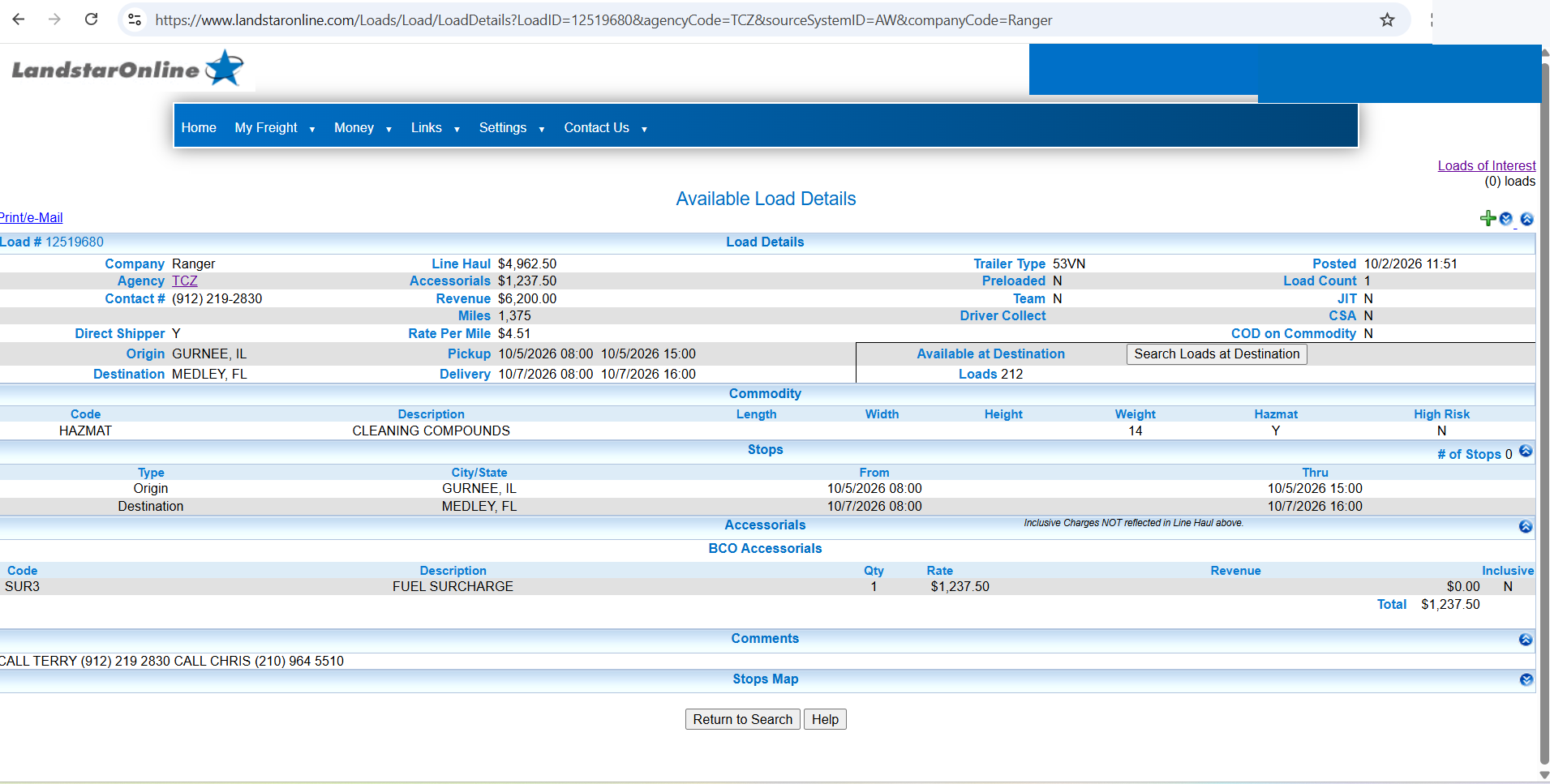
Count the miles to South Florida plus the deadhead back toward Atlanta, and the trip is about 2,193 miles. That brings the load down to about $2.03 per mile to the truck. Not great.
Could you improve that by grabbing a short Florida-to-Georgia load? Maybe. I found an Orlando to Dacula, Georgia load paying $1,038.21 with no fuel surcharge. At 65%, that's $674.84 to the truck. I wouldn't haul it myself, but as an example, adding it brings the total to $5,137.97 across roughly 2,134 miles. Now the combined move is about $2.41 per mile to the truck.
That's why the load board takes judgment. A load can be bad by itself but useful as part of a bigger move. Or it can look good by itself and fall apart once you count the empty miles.
Reverse engineer the search
Here's where you can use the board smarter. If $2.41 per mile to the truck is a number you're willing to run, divide it by 65%. That puts your line-haul filter around $3.70 per mile.
So I went back, lowered the rate filter from $4 to $3.70, and set a maximum of one stop. That opened the search back up to 293 loads.
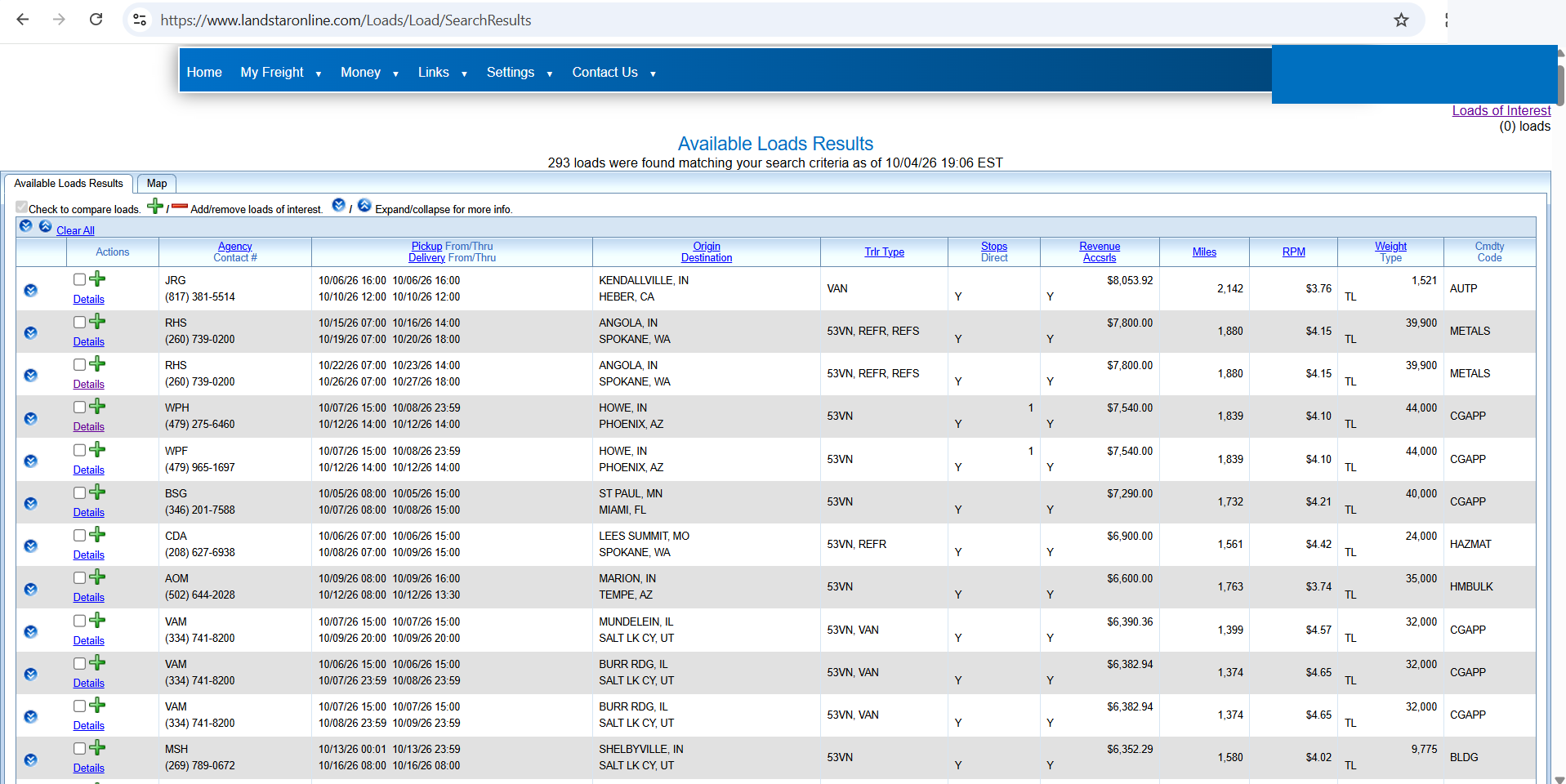
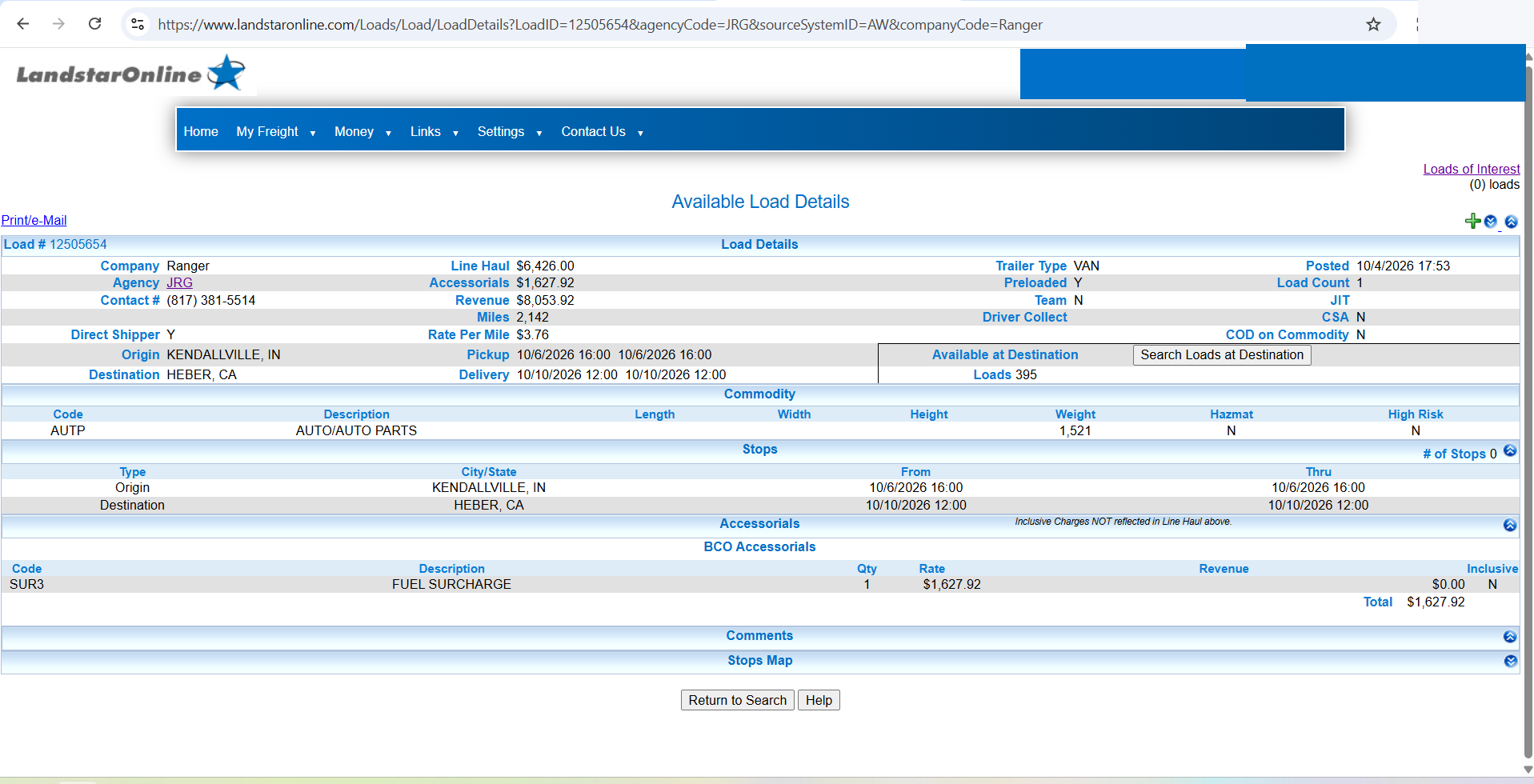
The first load that caught my eye was Kendallville, Indiana to Heber, California. I like longer loads when the numbers make sense, and this one was direct shipper, preloaded, no hazmat, no stops, and light.
The line haul was $6,426. At 65%, that's $4,176.90 to the truck. Add the $1,627.92 fuel surcharge and the total truck revenue is $5,804.82. Using practical miles, that came out around $2.78 per mile to the truck.
That's the difference between looking at a load board and actually using one. I'm not asking, "What's the highest rate on the screen?" I'm asking what the load does to my week, what it pays my truck, what risk comes with it, and where it leaves me.
The mistake is thinking the load board is the advantage
The Landstar freight board is a tool. It's not magic.
The advantage is knowing how to use it. Knowing when to move and when to sit. Building relationships so agents think of you before they throw freight on the board. Understanding your truck, your numbers, your lanes, and how much risk you can stomach.
If you come to Landstar expecting the load board to solve everything, you may be disappointed.
If you come in understanding that the board is one part of a bigger business model, it starts to make a lot more sense.
My honest take on searching for Landstar loads
If you're on the outside hunting for screenshots of the load board, I understand. I did the same kind of thing before I leased on.
Just don't let a screenshot make the decision for you.
From the outside, you won't see the best relationships. You won't see the fast-moving loads after they're gone. You won't see the calls that happen before a load gets posted. And you won't see whether a load that looks good would actually work for your truck.
What you can judge from the outside is the model.
Do you want to pick your own freight? Do you want to build agent relationships? Do you want to think about freight like a business owner instead of waiting for dispatch to feed you? Can you handle the responsibility when the decision is yours?
If the answer is yes, the Landstar load board can be a useful tool inside a system that gives you real control.
If the answer is no, seeing more loads on a screen probably won't fix that.
Ready to compare Landstar for yourself?
If the load board, relationships, and responsibility sound like the kind of setup you want, start the application here.
Start the Landstar application